Otomako

Product & automation studio

We turn manual work into systems that run.

We sort out the work your team repeats every day, the processes scattered across WhatsApp, email and spreadsheets, and the things off-the-shelf software doesn't cover. Sometimes that means automation; sometimes an internal tool, a dashboard, or a product built for you.

The tools you already use stay in place. The system is built around how your operation actually runs.

The path a workflow takes

Entry channels

  • Email
  • Web form
  • WhatsApp
  • CRM
  1. A request arrives
  2. Information is structured
  3. Rules are applied
  4. Routed to the right person
  5. A person decides
  6. The action completes
  7. The outcome is recorded

Steps needing judgement stay with your team

The typical shape of the flows we build. Every implementation is redefined around how your operation works. A request arrives on one of four channels; information is structured, rules are applied, it is routed to the right person, a human makes the decision, the action completes and the outcome is recorded.
  • Sort incoming email
  • Route the request to the right person
  • Prepare the quote
  • Pull data out of a document
  • Record the approval
  • Book the appointment
  • Send the reminder
  • Update the CRM
  • Log the form submission
  • Produce the report
  • Open a task for the team
  • Compare two lists

Context

Where does the time actually go?

These are the situations we meet most often, whatever the industry. None of them come from a careless team — they all come from a process that was never written down as a system.

  • Requests scatter across channels

    Email, the web form, WhatsApp and the phone are each followed separately. Which request went unanswered often isn't clear even at the end of the day.

  • The process lives in one person's memory

    Who does what, and when, isn't written down as a rule. When that person is away, the process stops with them.

  • The same data is typed into several systems

    The spreadsheet, the CRM and finance each want the same details. Every copy costs time and invites an error.

  • Work waits on approvals and documents

    The places where a signature, a check or a missing document holds work for days are the most expensive points in an operation.

  • Detail is lost at every hand-off

    Moving between teams, someone asks what the request was all over again. Each repeat costs time and confidence.

  • Reporting is retrospective and manual

    How many requests arrived last month, how many closed, where they waited — the answer is assembled by hand from spreadsheets.

None of this is solved by buying another piece of software. The process has to be defined first, and only then should the right parts of it be turned into a system.

Solutions

We do three kinds of work.

Most companies start with a single job. Depending on its size we automate it, build an internal tool for it, or write a product from scratch.

Operations automation

We put the work that repeats every day onto written rules. What happens when a request arrives, who approves it, where it gets recorded and who hears about it are all settled up front.

Scope

  • Requests and tasks collected into one flow
  • Routing and prioritisation rules
  • Approval steps and hand-offs between teams
  • Document flows and structured data capture

Boundary

Automation covers work whose rules can be written down. Steps requiring judgement are not automated; the system flags them and routes them to the person responsible.

See the detail

Internal tools and AI systems

We replace scattered spreadsheets and separate screens with one workspace built around your team. Where a narrow job needs it — reading, classifying or summarising documents — we add AI to the system.

Scope

  • Operational dashboards and internal screens
  • Document reading, classification and field extraction
  • Structured search and internal knowledge interfaces
  • Summarisation and draft generation

Boundary

The AI layer proposes, records the decision and shows its reasoning. Authority to approve the result stays with your team.

See the detail

Custom digital products

If off-the-shelf software doesn't fit your process, we build the portal, the customer panel or the web application from scratch. The product is set up in your name.

Scope

  • Product definition, scope and interface design
  • Portals and customer panels
  • SaaS products and subscription flows
  • Authentication, authorisation and role management

Boundary

You own the product. Code, accounts and documentation are set up in your name; you are not tied to the studio.

See the detail

Systems we work with often

  • Google Workspace
  • Microsoft 365
  • WhatsApp Business
  • HubSpot
  • Airtable
  • Notion
  • Slack
  • Webhook / REST API

Case Studies

From strategy to a product in production.

Wiring up automation and building a product are different work. We defined Listedra, built its brand and interface, and took it to production.

One product for the whole listing-media operation.

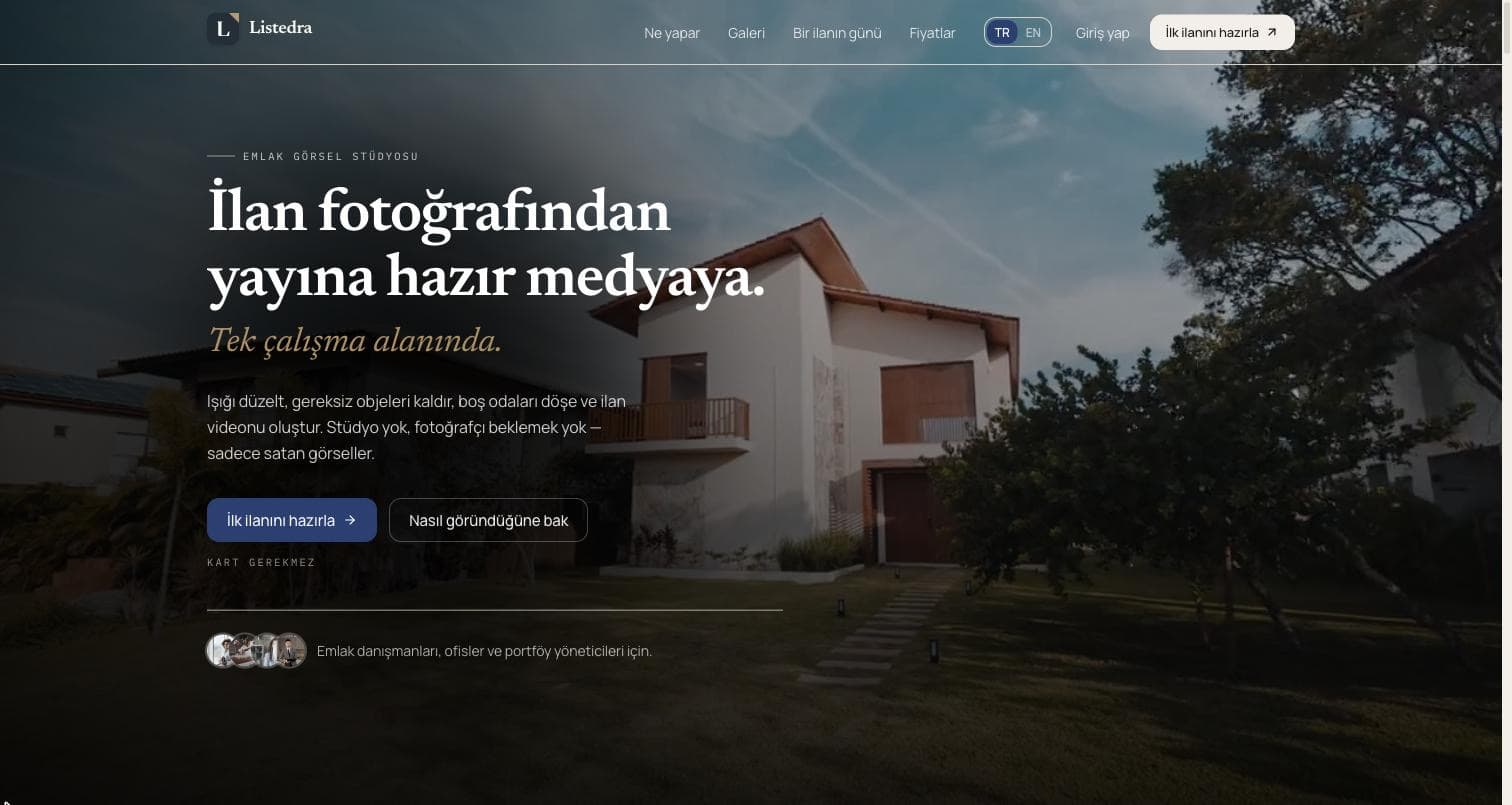
Listedra is the workspace real-estate professionals use to prepare listing media. Otomako defined the product, built its brand and interface, developed the bilingual application and took it to production.

Product
Listedra
Sector
Real estate
Year
2026
Listedra home page: the product headline, description and two actions.

The product is live: brand, interface and promise on one screen.

Read the case study

Our own productWellness and health-travel portal · In development

All case studies

Healthcare

Practical experience in healthcare

We have worked with doctors and clinics on websites, digital communication and digital presence. Today we bring that experience together with product development and operational automation.

  • We know the coordination load

    A day where enquiries arrive on four channels, appointments move by phone and follow-up lives in one person's memory doesn't need explaining to us.

  • Patient communication is an operations problem

    Response time, routing and record-keeping are a manageable, measurable flow — separate from the clinical quality of the practice.

  • Multilingual enquiry flow

    International enquiries bring translation, time zones and consistency. Those are infrastructure problems.

See our healthcare work

How we work

We define the scope up front and make delivery measurable.

Every project runs through the same six steps. Scope is written first, and what will be delivered is known before anything is built.

  1. Discovery and process audit

    Output

    Process map and bottleneck list

  2. Scope

    Output

    Scope document, timeline and fixed proposal

  3. Build

    Output

    Working system in a test environment

  4. Validation

    Output

    Test records and corrections

  5. Launch

    Output

    Live system and rollout notes

  6. Measure, hand over and support

    Output

    Operational report, documentation, training and optional support

The full process

Why Otomako

No two operations run the same way, and neither do the systems we build.

Otomako is an independent product and automation studio. We turn complicated business processes into digital systems people can actually run.

  • Understanding the process

    We work out how the job runs first. Scope comes out of the process map.

  • Product thinking

    We define the problem to be solved rather than the feature to be built, and we don't ship screens nobody opens.

  • Engineering depth

    When off-the-shelf tools run out we build the product itself — and we can point at a live one.

  • One point of contact

    The same team from analysis to handover. Responsibility doesn't scatter between steps.

About the studio

If something still runs by hand, start there.

Tell us about the work that repeats, runs late or scatters between systems. In the first conversation we'll work out whether it's worth automating and where to begin.

Or write to us directly:

The form takes a couple of minutes.

Workflow brief
How should we reply?

All fields are required.